
Marketing Without Visibility: Why Some Brands Remain Invisible Online
Introduction
In today’s digital-first landscape, maintaining an online presence is no longer a differentiator, it is a fundamental requirement. Yet, many businesses invest in websites, social media platforms, and digital campaigns without achieving meaningful visibility.
This disconnect between being present online and being discoverable remains one of the most significant challenges in modern digital marketing. Simply publishing content or launching a website does not guarantee traffic, engagement, or conversions.
True visibility is achieved through a well-structured strategy that integrates search intent, high-quality content, technical optimization, and effective distribution.
Understanding Online Visibility in Digital Marketing
Online visibility refers to how easily a business can be discovered across digital channels, including search engines, social media platforms, and emerging AI-driven search systems.
Many businesses may already have:
- A professionally designed website
- Active social media profiles
- Regular content updates
However, without strategic optimization, they often face:
- Low organic traffic
- Minimal audience engagement
- Weak lead generation
This gap between presence and performance is commonly referred to as the visibility gap.
Why an Online Presence Alone Is Insufficient
A common misconception is that launching digital assets automatically leads to visibility. In reality, visibility is governed by complex algorithms and user behavior patterns.
Key factors influencing discoverability include:
- Search engine ranking signals
- Content relevance and depth
- Domain authority and credibility
- Platform-specific algorithms
- User engagement metrics
Without optimizing these elements, even well-established businesses can remain largely unnoticed online.
Key Reasons Brands Struggle with Online Visibility
Misalignment with Search Intent
Businesses often create content based on internal priorities rather than user needs.
Best Practice:
- Conduct intent-driven keyword research
- Target informational, navigational, and transactional queries
- Use question-based content formats
Weak SEO Foundation
A lack of strong SEO fundamentals significantly limits search performance.
Common Issues:
- Poorly optimized meta tags
- Ineffective keyword integration
- Slow website performance
- Weak internal linking structure
Best Practice:
- Strengthen on-page and technical SEO
- Build a structured keyword strategy
Absence of a Clear Content Strategy
Publishing content without a defined direction leads to inconsistent results.
Best Practice:
- Develop a content calendar
- Focus on niche-specific topics
- Maintain consistency in publishing
Low-Value or Thin Content
Search engines prioritize depth, relevance, and user value.
Impact:
- Reduced engagement
- Higher bounce rates
- Lower rankings
Best Practice:
- Create comprehensive, user-focused content
- Incorporate data, examples, and actionable insights
Lack of Authority Signals (Off-Page SEO)
External validation is critical for improving credibility and rankings.
Missing Elements:
- High-quality backlinks
- Brand mentions
- Customer reviews
Best Practice:
- Invest in backlink building
- Encourage user-generated content
- Leverage digital PR
Ineffective Social Media Utilization
Many brands focus on posting rather than meaningful engagement.
Best Practice:
- Share valuable and interactive content
- Engage consistently with the audience
- Build a community-driven presence
Weak Content Distribution Strategy
Content without promotion has limited reach.
Best Practice:
- Distribute across multiple channels
- Repurpose content into various formats
- Use email marketing to amplify reach
Lack of Optimization for AI and Voice Search
Modern search behaviour increasingly relies on conversational queries.
Best Practice:
- Use natural, conversational language
- Provide direct, concise answers
- Include FAQ sections
Inconsistent Branding Across Platforms
Inconsistency reduces trust and weakens recognition.
Best Practice:
- Maintain consistent NAP (Name, Address, Phone) details
- Standardize brand identity across all channels
Absence of Performance Tracking
Without data-driven insights, optimization is not possible.
Best Practice:
- Use analytics tools to monitor performance
- Identify high-performing content
- Continuously refine strategies
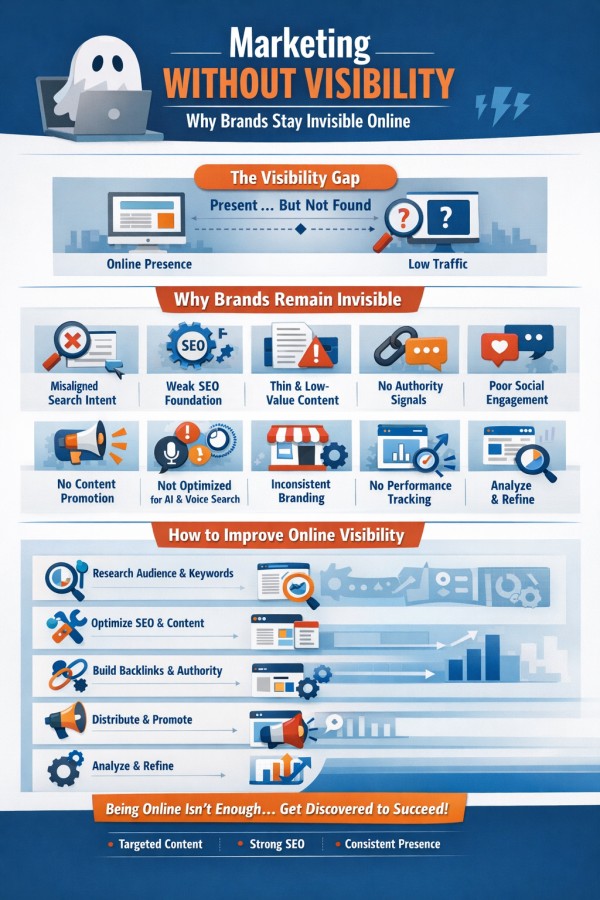
A Strategic Framework to Improve Online Visibility
To bridge the visibility gap, businesses should adopt a structured approach:
- Research: Understand audience behaviour and search patterns
- Optimize: Implement SEO and content best practices
- Build Authority: Strengthen credibility through backlinks and trust signals
- Distribute: Promote content across multiple channels
- Analyze: Measure performance and refine strategies
Common Mistakes That Limit Visibility
- Relying solely on having a website
- Ignoring SEO fundamentals
- Publishing low-value or inconsistent content
- Neglecting content promotion
- Failing to adapt to changing search trends
Conclusion
In a highly competitive digital environment, visibility is not automatic, it is the result of deliberate and strategic execution.
Businesses that struggle to gain traction often do so because of weak SEO practices, lack of structured content strategies, and insufficient authority building.
To achieve sustainable growth, organizations must move beyond simply existing online and focus on becoming discoverable.
Successful brands consistently:
- Align content with user intent
- Deliver high-quality, valuable information
- Build credibility and trust
- Adapt to evolving search technologies
Ultimately, online visibility is not optional, it is the foundation of long-term digital success.